

Publish Date: January 8, 2025
Author: Seubert
Tags: Blog - SeubertU
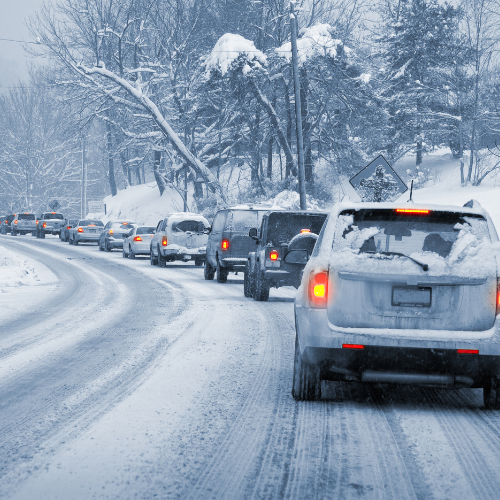
Winter can create hazardous driving conditions across much of the United States. With slippery surfaces, dangerously cold weather, and visibility issues prevalent during these months, drivers must take steps to ensure they operate their vehicles safely to protect themselves, others, and business property (e.g., trucks, trailers, and cargo).
Below are maintenance and driving tips that can help prevent accidents and improve road safety during the winter season.
Inspection and Maintenance
Inspecting vehicles and trailers and properly maintaining them are essential to stay safe on the road in the winter. Equipment, parts, fluids, and other aspects to check include the following:
- Tires should be inspected; this includes checking that the treads are sufficient for winter driving and ensuring tire pressure is adequate for cold weather.
- The battery, including its age, condition, voltage, and connections, should be examined. Its cold-cranking amps should also be tested.
- Fifth-wheel lubrication should be adequate, ensuring a winter-grade product is in use.
- The vehicle and trailer’s exterior must be cleared of ice and snow buildup before departing. Couplers, suspensions, and the trailer’s structural integrity should also be assessed.
- The heater and defroster should be inspected, as these may not have been used since the previous winter.
- Windshield washer fluid should be measured, and a winter formulation should be used.
- Windshield water nozzles and wiper blades should be checked to make sure they are functional.
- Cargo should be securely fastened and prepared for cold weather before departure.
- Lights, including turn signals, should be operational.
Weather and Road Conditions
Being aware of weather and road conditions is essential for safe winter driving. Staying up to date on weather reports and temperatures can help drivers know if the conditions may be slippery or if visibility is reduced. Additionally, noticing sliding vehicles, a lack of spray from tires, and ice buildup on others’ vehicles can indicate freezing conditions.
Safe Driving Practices
Drivers must adapt to winter road conditions by taking appropriate actions, such as:
- Staying alert
- Avoiding distractions
- Reducing speed
- Maintaining a safe following distance
- Avoiding cruise control use
- Braking and accelerating with caution
- Not passing snowplows
- Sharing the road
- Properly using the inter-axle differential lock if needed
Additionally, it is important to know how to react to common issues that may arise, including:
- Frozen brakes—The brake lining may freeze to the drum if brakes are set while still wet in cold weather. To fix this, drivers can gently rock the trailer back and forth, cut and resupply the air supply, tap the brake drum with a hammer to break up the ice, or let the brakes thaw as it warms. Brake de-icing products may also be available.
- Skidding—If skidding occurs while driving, drivers should remain calm, depress the clutch, and steer to get back in line with the trailer. Braking should be avoided.
- Jack-knifing—Drivers should not panic and try to correct the jack-knife by gradually steering until the trailer and tractor are realigned. Brakes should not be used until the driver feels the trailer straightening (some may choose to use the Jake brake at this point). Drivers should then gently feather the accelerator when regaining control to end the skid. Slowly pulling over after a jack-knife can help calm drivers’ nerves.
Winter poses unique driving challenges, and it is crucial for drivers to implement measures to stay safe during this season.
Contact us to see how you could minimize risk:
Recent News
Hiring the Right Drivers: Building a Safer Fleet From the Start
Careful recruiting and screening help build a safer, more reliable workforce.
Weather Preparedness Around the Year: Real-World Strategies for Construction and Transportation Businesses
Learn seasonal weather preparedness strategies that help construction and transportation businesses reduce claims, speed recovery, and stabilize premiums.
Transportation DOT Roundtable Event
Join Seubert for an in-depth roundtable discussion designed to help transportation companies protect their operations, their drivers, and their bottom line.
Construction OSHA Roundtable Event
Join Seubert and our panel of safety experts for a candid, practical conversation on the issues that matter most to your business and your workforce.
Employee Spotlight: Brian McCarthy
Please help us in welcoming Brian McCarthy to the Seubert Team! Scarlett joins Seubert’s Commercial Lines Division as a Client Service Associate.
Wrap-up Insurance Programs for Construction Projects
Project owners and general contractors can turn to a wrap-up insurance program, sometimes called a controlled insurance program, to centralize insurance and loss control for the entire project under a single policy or set of policies.