

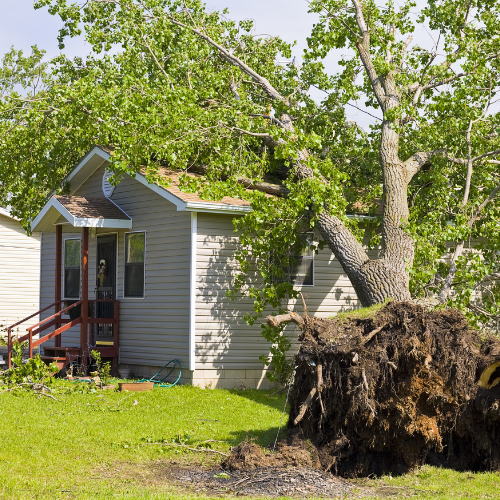
Building codes are established by state and local officials and provide standards for safe construction practices. They play an essential role in safeguarding structures during natural disasters, and they are tailored to specific hazards prevalent in different regions. For example, in wildfire-prone areas, building codes may require the use of fire-resistant roofing materials. On the other hand, in hurricane-prone areas, certain structural elements may be mandated to withstand strong winds.
The effectiveness of modern building codes in reducing property damage during adverse weather conditions has been analyzed by the Federal Emergency Management Agency (FEMA). In a recent study, the agency stated that adopting and enforcing hazard-resistant building codes in Florida and California—two disaster-prone states—can result in significant long-term savings in property losses. The study also revealed that every dollar spent on constructing properties in accordance with modern building codes can save $11 in disaster repair and recovery expenses.
Additionally, a study conducted by the Wharton School of the University of Pennsylvania found that the implementation of statewide building codes across Florida—known as the Florida Building Code (FBC)—has been linked to a 72% reduction in property damage from wind-related events. The study also revealed that for every dollar spent on FBC compliance, property losses dropped by an estimated range of $2 to $8.
Altogether, this research demonstrates the substantial benefits associated with adopting effective building codes throughout communities, as they can make all the difference in safeguarding properties during destructive weather events. Furthermore, there are potential coverage advantages for businesses that ensure their commercial properties comply with building codes, including insurance discounts and reduced claim costs.
However, not all areas have adopted or enforced modern building codes, making businesses located in these areas more susceptible to property damage amid natural disasters. One reason for this lack of adoption or enforcement could be that community leaders don’t have the information they need to quantify the long-term advantages of stronger building codes and, in turn, can’t justify the initial investments necessary for implementing such codes. In areas with poor adoption or enforcement of commercial building codes, voluntary implementation of International Codes and adherence to disaster-specific structural safety measures from the Insurance Institute for Business and Home Safety is crucial.
Amid growing concerns regarding natural disasters in the United States, taking proactive measures and ensuring compliance with building codes can help businesses promote property resilience, thus minimizing potential losses stemming from these disasters. For additional guidance, contact Seubert & Associates, Inc.
A FEMA study examining data from all U.S. states found that the adoption of modern building codes can help prevent an annual average of $484 million in flood-related property damage, $60 million in earthquake-related damage, and $1.1 billion in hurricane-related wind damage for structures built after 2000.
Contact us to see how you could minimize risk: