

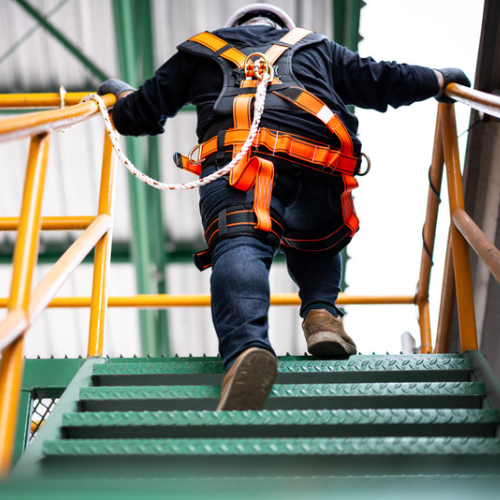
Falls are an ever-present risk in the construction industry. According to the U.S. Department of Labor’s (DOL) Bureau of Labor Statistics, there were 353 deaths attributed to fatal falls to a lower level in 2020. The DOL has also stated that an average of40 workers die each year due to falls from residential roofs.
Implementing fall prevention measures can help keep employees safe and reduce the risk of these tragedies. In fact, OSHA directs residential builders to comply with fall protection requirements.
Who Is Involved in Fall Protection?
Employers engaged in residential construction must provide fall protection for workers operating 6 feet or more above lower levels. Residential construction refers to work that meets the following criteria:
- The structure being built has an end-use as a home (e.g., dwelling).
- The structure is built using traditional wood frame construction materials and methods. A structure is not disqualified from being considered residential construction even if limited structural steel is used in a predominantly wood-framed house.
All employers involved in residential construction must adhere to OSHA regulations concerning fall protection systems. These standards require that employees working 6 feet or more above lower levels must utilize at least one of the following:
- Guardrail systems
- Safety net systems
- Personal fall arrest systems, such as one with a full-body harness, deceleration device, lanyard and anchor point
- In lieu of a personal fall arrest system, employees may use an effective fall restraint system in some cases to prevent themselves from reaching a fall hazard and falling over the edge. For instance, a full-body harness or body belt could be connected to an anchor point at a roof’s center with a lanyard, the length of which prevents a worker from being able to reach the edge of the roof.
- As specified by OSHA, certain types of work may warrant or necessitate other fall protection equipment. For example, guardrail systems for workers on steep roofs must have toe boards.
What if Conventional Fall Protection Is Infeasible?
In some circumstances, utilizing conventional fall protection measures may be infeasible or create a greater hazard. If an employer can demonstrate this impracticality, a qualified person must generate a written, site-specific fall protection plan that meets OSHA regulations. The plan must also explain why conventional fall protection systems are infeasible or how utilizing them would create a greater hazard.